Subterranean termite activity in Worcester County centers heavily on aging building envelopes where original timber meets moist soil. Older multi-family triple-deckers along Grafton Hill, Vernon Hill, and Main South…
Subterranean termite activity in Worcester County centers heavily on aging building envelopes where original timber meets moist soil. Older multi-family triple-deckers along Grafton Hill, Vernon Hill, and Main South frequently feature stacked fieldstone foundations or porous brick footings. Subterranean workers construct cellulose-and-soil shelter tubes across these damp surfaces to reach structural sill plates without dehydrating. In properties surrounding Indian Lake, Green Island, and the wetlands near Lake Quinsigamond, elevated ground moisture accelerates this migration, rendering over-the-counter surface sprays ineffective because topical solutions fail to penetrate concealed mud tubes or reach subterranean colonies nested 4 to 10 feet below the frost line.
Effective elimination requires non-repellent liquid barriers, such as fipronil formulations applied at 4 gallons per 10 linear feet per foot of depth, or perimeter bait systems spaced at 10-foot intervals around the structural footprint. A full liquid barrier establishes an undetectable lethal zone that termites track back through social grooming to eradicate the subterranean queen. Spot applications fit small additions or isolated porch footers, while complete perimeter barrier treatments suit continuous foundation footprints; the structural trade-off balances targeted chemical volume against the risk of unintercepted worker leads bypassing isolated application sectors.
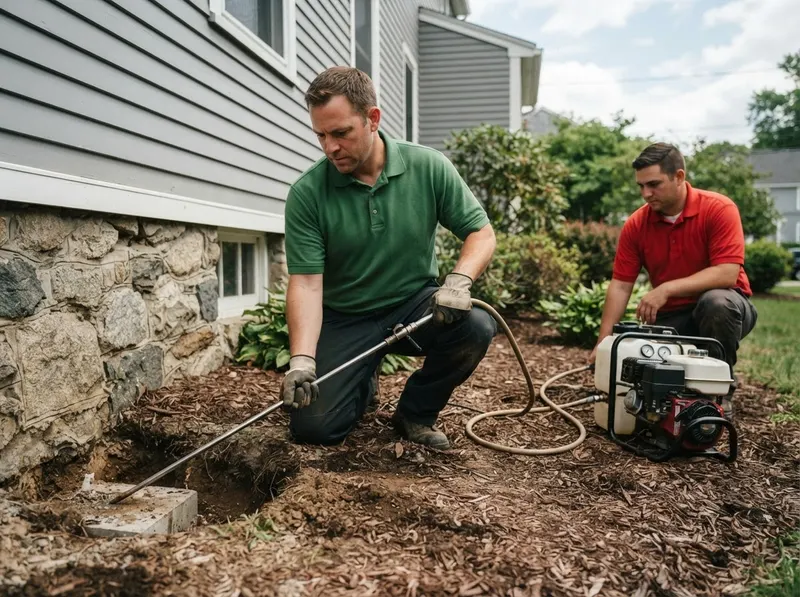
Remediation protocols account for complex foundation variations common in Tatnuck, Burncoat, Salisbury Street, and Shrewsbury Street. 1. Technicians measure perimeter linear footage and drill finished basement concrete slabs at 12-inch intervals adjacent to load-bearing walls. 2. Low-pressure chemical pumps inject non-repellent termiticide beneath the concrete floor to saturate sub-slab gravel beds. 3. Exterior foundation perimeters undergo 6-inch by 6-inch mechanical trenching to bond termiticide securely with backfilled soil. 4. Tamper-resistant bait stations are seated flush into surrounding turf for long-term colony monitoring. This protocol provides targeted eradication and permanent structural exclusion, avoiding ongoing unnecessary monthly recurring charges once active subterranean colonies collapse.
Every job gets a firm, written price after a free on-site visit.
Tell us about your subterranean termite remediation job in Worcester and we'll send a clear, written quote, usually the same day.
 Brelvix Exterminators